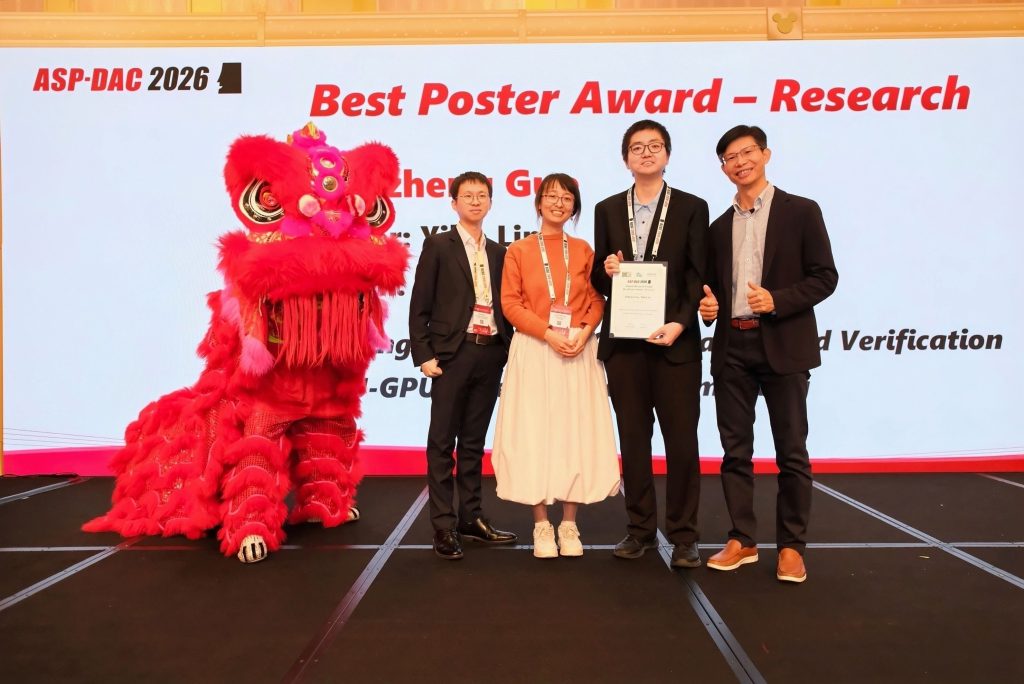
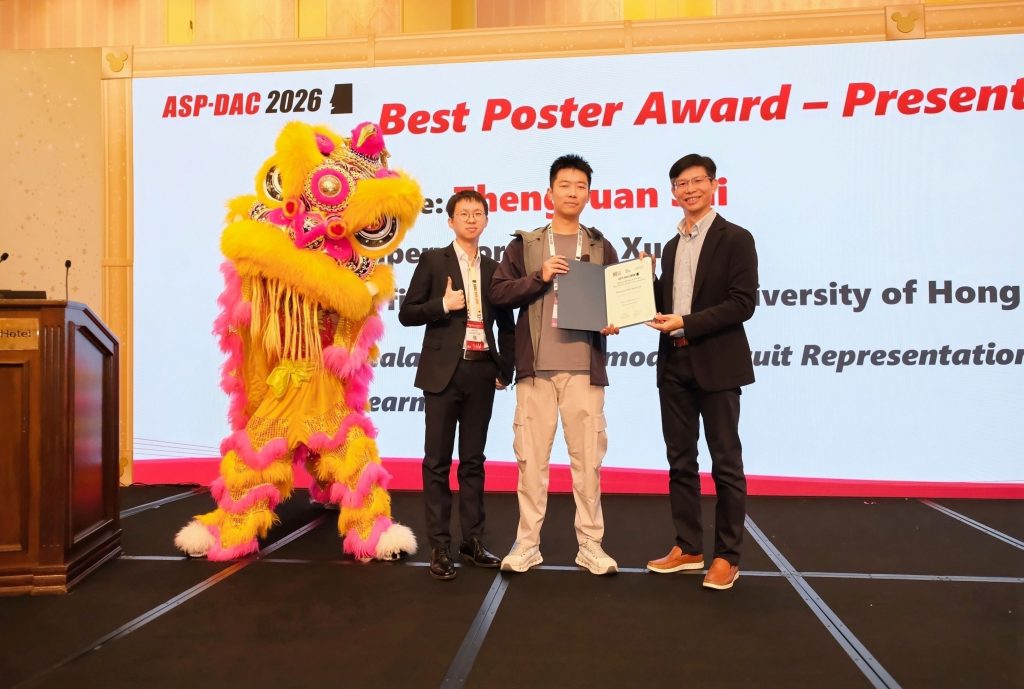
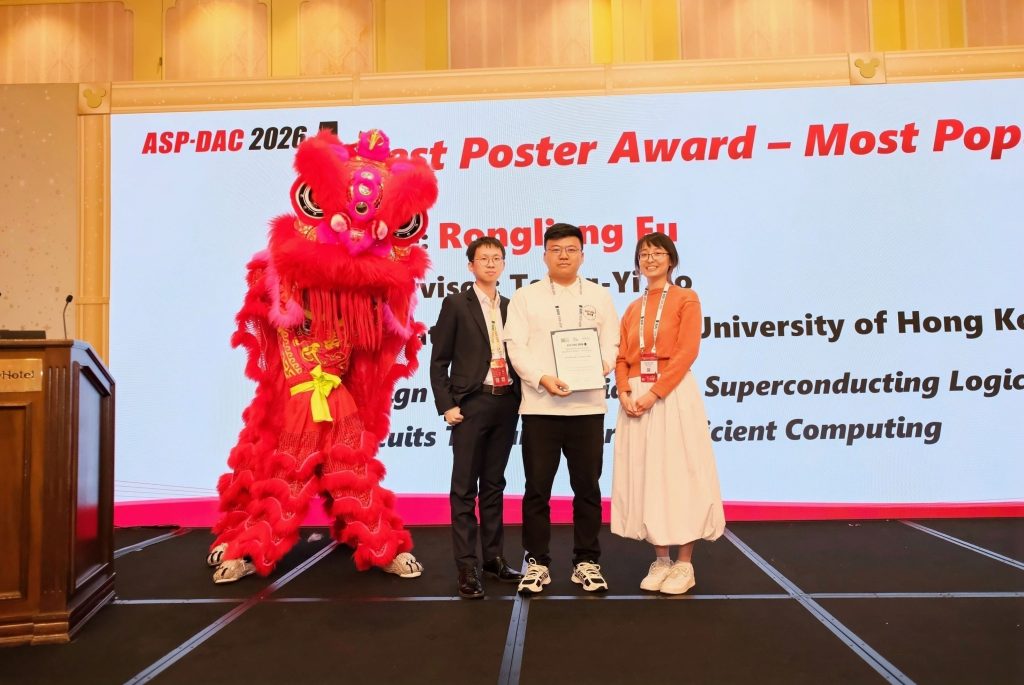
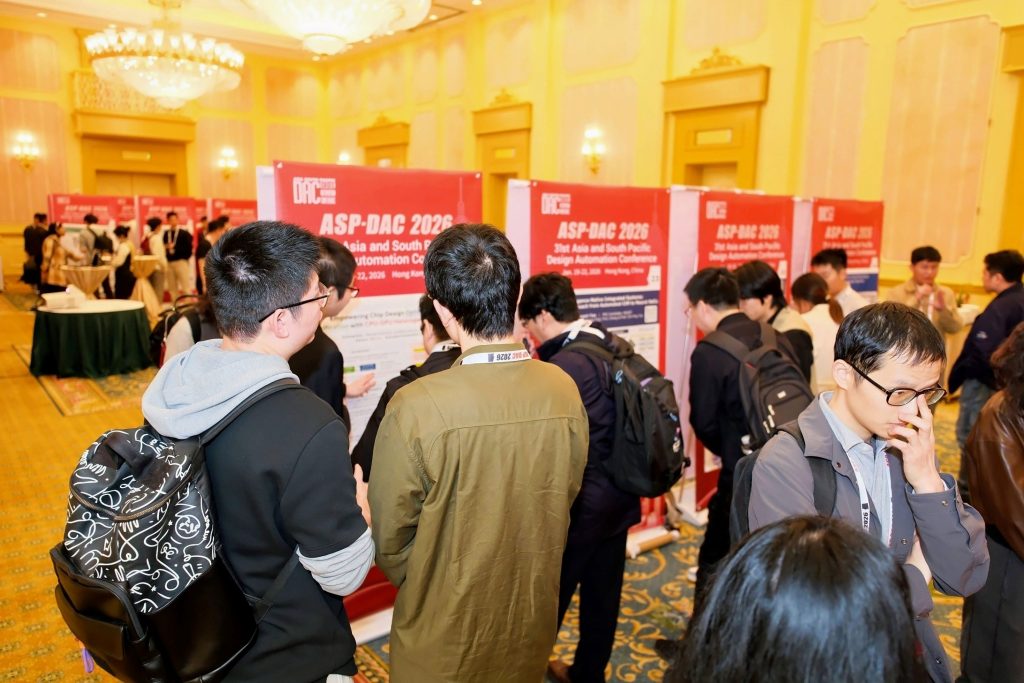
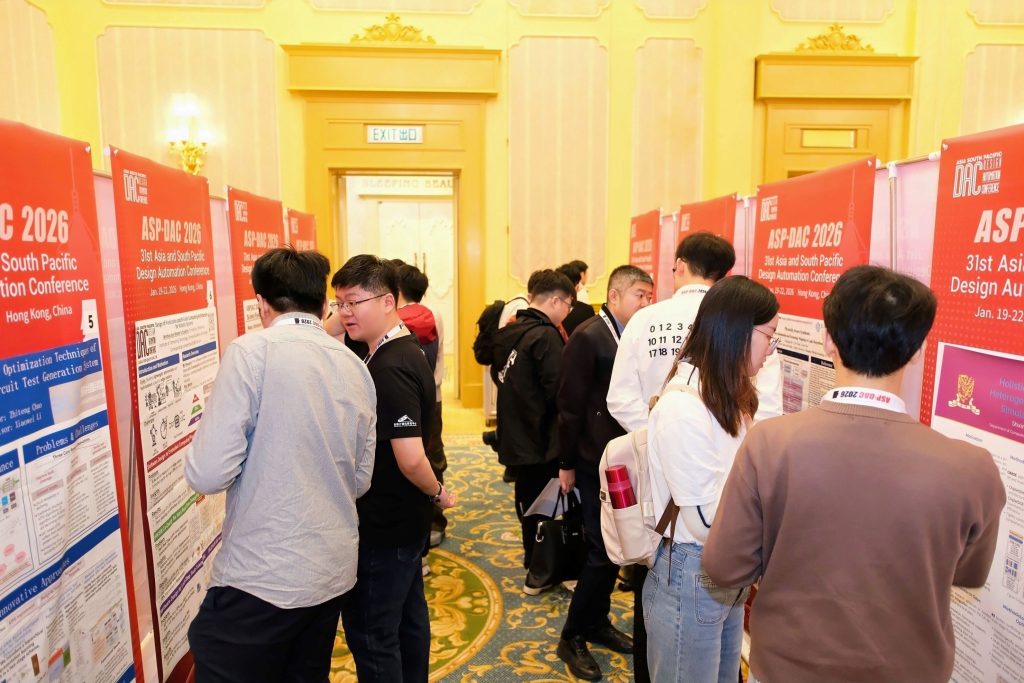
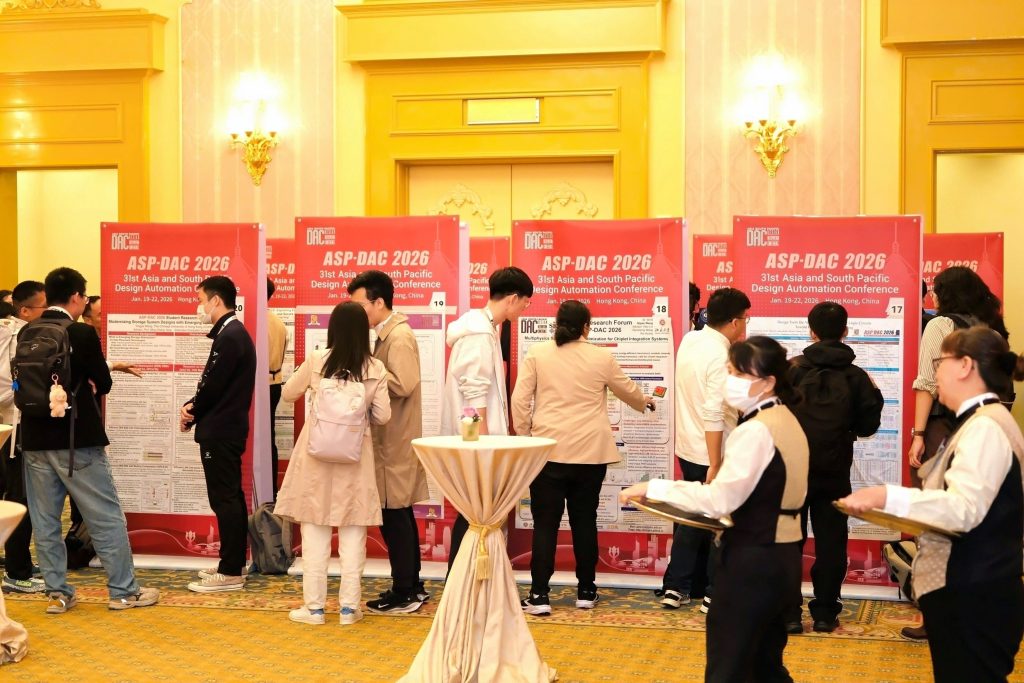
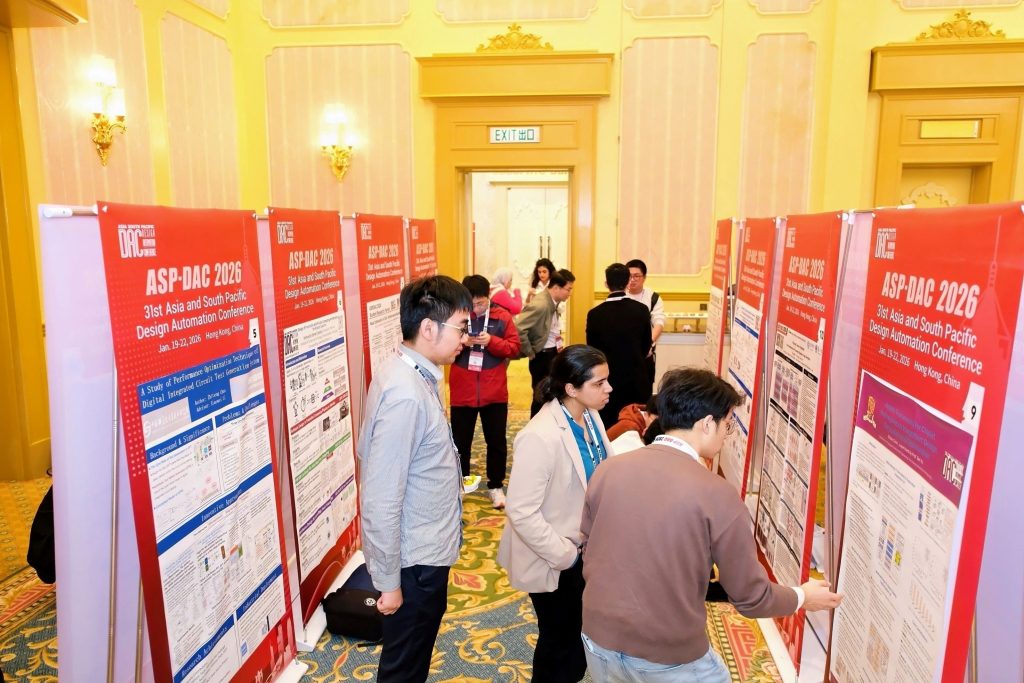
The Student Research Forum (SRF) at ASP-DAC 2026 was a vibrant showcase of emerging research and student innovation. This year, the forum received 39 submissions, with 29 posters accepted—a record-high number for the SRF—and three awards presented to recognize outstanding contributions across research quality, presentation, and community engagement.
🏆 SRF Award Winners
Best Poster Award – Best Research Zizheng Guo, supervised by Yibo Lin (Peking University)
Best Poster Award – Best Presentation Zhengyuan Shi, supervised by Qiang Xu (Chinese University of Hong Kong)
Best Poster Award – Most Popular Rongliang Fu, supervised by Tsung-Yi Ho (Chinese University of Hong Kong)
📸 Event Highlights
Highlights from the SRF award ceremony and poster session at ASP-DAC 2026.
👩⚖️ Award Judges
We sincerely thank the award judges for their careful evaluation and dedication to fairness. Poster assignments were made with strict conflict-of-interest (COI) considerations. (In addition to the judges listed below, other SRF committee members contributed to the first-round review; they are not listed here.)
Jianlei Yang — Beihang University
Zhenge Jia — Shandong University
Lang Feng — Sun Yat-sen University
Shiju Lin — Hong Kong University of Science and Technology (Guangzhou)
Hongce Zhang — Hong Kong University of Science and Technology (Guangzhou)
Yuzhe Ma — Hong Kong University of Science and Technology (Guangzhou)
Qi Sun — Zhejiang University
Bonan Yan — Peking University
Zhiang Wang — Fudan University
Zhiding Liang — Chinese University of Hong Kong
Cong “Callie” Hao — Georgia Institute of Technology
Yibo Lin — Peking University
Vidya A. Chhabria — Arizona State University
Xiang Chen — Peking University
Andy Yu-Guang Chen — National Central University
The SRF continues to be a cornerstone for student engagement at ASP-DAC, fostering dialogue, feedback, and visibility for early-stage research. Congratulations to all participants and award recipients!
Organizer: Zhiyao Xie, Hong Kong University of Science and Technology
ACM TODAES 2026 Call for Nominations: Best Paper Award, Rookie Author of the Year Award, Test of Time Paper Award
ACM Transactions on Design Automation of Electronic Systems (TODAES) is seeking nominations for the 2026 TODAES Best Paper Award. The nomination deadline is February 10, 2026.
All papers published in the ACM TODAES between January 2025 and December 2025 are eligible. The best paper will be selected based on originality, timeliness, potential impact and overall quality.
The award will be announced and recognized during the 2026 Design Automation Conference, July 26-29, 2026, Long Beach, CA.
A nomination should include the following material:
Name and email of the nominator
Title and author list of the paper, and the issue in which the paper was published
A brief supporting statement of no more than 200 words
A PDF copy of the paper
Submit the nominations using this link: https://forms.gle/jLdGSSa6uSkac3bA9. For any questions, email Ann Franchesca Laguna, Managing Editor of ACM TODAES, at ann.laguna@dlsu.edu.ph.
Both nominations by peers and self-nominations are welcome.
Contacts:
Ann Franchesca Laguna at ann.laguna@dlsu.edu.ph
Jiang Hu: jianghu@tamu.edu
TODAES Rookie Author of the Year (RAY) Award
ACM Transactions on Design Automation of Electronic Systems (TODAES) introduced the TODAES Rookie Author of the Year (RAY) Award, which aims to highlight the achievement of junior researchers in the Design and Design Automation of Electronic Systems field. Specifically, the award recognizes an author whose first-ever peer-reviewed journal paper as a lead author is published in ACM TODAES.
The lead author of a paper refers to the author who contributed the most to the submission. Since people may adopt different ways to order the authors, any nomination for the RAY Award must make it clear that the nominee is the lead author. If two authors satisfy this requirement (meaning they made equal contributions and are both rookie authors), both can receive the RAY award.
We are now seeking nominations for the 2026 TODAES RAY Award. The nomination deadline is February 10, 2026. All papers published in the ACM TODAES between January 2025 and December 2025 are eligible. The RAY award will be selected based on originality, timeliness, potential impact, and overall quality. The RAY award will be announced and recognized during the 2026 Design Automation Conference, July 26-29, 2026, Long Beach, CA.
A nomination should include the following material:
Name and email of the nominator
Title and author list of the paper, and the issue in which the paper was published
Confirmation that the paper is the first peer-reviewed journal publication in ACM or IEEE, where the nominee is the lead author.
A brief supporting statement of no more than 150 words.
A PDF copy of the paper
Submit the nominations using this link: https://forms.gle/36YAq2TZ6cemxrdVA by February 10, 2026. If you have questions, e-mail Ann Franchesca Laguna at ann.laguna@dlsu.edu.ph, Managing Editor of ACM TODAES, at ann.laguna@dlsu.edu.ph. No self-nomination is allowed.
ACM Transactions on Design Automation of Electronic Systems (TODAES) introduced the TODAES Test of Time Paper Award. This award will recognize an outstanding paper that was published in TODAES at least 10 years ago and has created a significant impact in the field of EDA.
We are now seeking nominations for the 2026 TODAES Test of Time Paper Award. The nomination deadline is February 10, 2026. As the inaugural Test of Time Paper Award selection, eligibility is restricted to papers published in ACM TODAES between January 1996 and December 2005. The award will be selected based on evident impact in the field of EDA. The award will be announced and recognized during the 2026 Design Automation Conference, July 26-29, 2026, Long Beach, CA.
A nomination should include the following material:
Name and email of the nominator
Title and author list of the paper, and the issue in which the paper was published
A brief supporting statement of no more than 200 words
One sentence quote that summarizes the impact of this paper
A PDF copy of the paper
Submit the nominations using this link: https://forms.gle/55NajeW5eU6YqUtH8 by February 10, 2026. If you have questions, e-mail Ann Franchesca Laguna at ann.laguna@dlsu.edu.ph, Managing Editor of ACM TODAES, at ann.laguna@dlsu.edu.ph. No self-nomination is allowed.
The IEEE Computer Architecture Letters (CAL) seeks applicants for the position of editor in chief (EIC), begin on 1 January 2027 and are for two years, pending reappointment for an additional two years, unless noted otherwise below.
This role provides an opportunity to lead the journal’s editorial direction, ensure high-quality and timely publications, and serve the computer architecture research community.
Starting January 1, 2026, all ACM publications (including those from SIGDA-sponsored conferences) will be 100% Open Access under ACM’s new publishing model. Authors whose institutions are not part of the ACM Open program will be required to pay an Article Processing Charge (APC) unless they qualify for a waiver or discount.
To ease this transition and ensure inclusiveness, SIGDA has established the Financial Hardship Waiver (FHW) program for 2026. This initiative, jointly funded by ACM and SIGDA, provides a limited number of waivers to cover APCs for eligible authors presenting at SIGDA-sponsored conferences.
Eligibility Criteria
Requests will be evaluated according to ACM’s and SIGDA’s guidelines. To qualify, all of the following conditions must be met:
All authors must be affiliated with institutions not participating in ACM Open.
The corresponding author must be a current SIGDA member.
Papers with co-authors affiliated with for-profit companies are not eligible, as such organizations are expected to cover publication costs for their employees.
Priority will be given to authors from low-income countries or from institutions and research groups without active grant funding. Additional documentation may be requested.
Application Procedure
Waiver requests can only be submitted after the paper is accepted, during the ACM e-rights process. Authors should select the waiver request option available within the ACM e-rights system and provide the requested information. Requests will be jointly evaluated by the Program Chair of the respective conference and the SIGDA FHW Committee based on the established eligibility criteria.
—
For more information about ACM Open, participating institutions, and ACM’s waiver policy, please visit: https://libraries.acm.org/acmopen
Remembering Arvind: From Friends, Colleagues, and Students
It is with a heavy heart that we write to share the news that on June 17th 2024, we lost our beloved colleague, mentor, and friend Arvind Mithal. Arvind passed away at 77 years old, after an illness he was being treated for took a sudden turn for the worse.
Arvind was a pioneer in computer architecture and digital systems. Over his five decades at MIT, he contributed countless foundational techniques, spanning dataflow architectures, parallel processors and programming languages, hardware description languages, and synthesis and verification of digital systems. Arvind made lasting contributions to hardware and architectural abstractions for both correctness and efficiency.
Arvind received a B.Sc. in Electrical Engineering from IIT Kanpur in 1969, followed by a M.Sc. and Ph.D. in Computer Science from the University of Minnesota in 1972 and 1973, respectively. He taught at UC Irvine from 1974-78 before moving to MIT in 1978. He received several awards during his illustrious career, including distinguished alumni awards from both his alma maters. Arvind became an IEEE Fellow in 1994 and an ACM Fellow in 2006. He was also elected to the National Academy of Engineering in 2008.
Arvind’s presence in the computer architecture community will continue to be felt via his legacy of deep technical contributions and his academic lineage. Arvind advised over 35 Ph.D. students during his career, who have all gone on to become leaders in academia and industry.
Arvind was a deep thinker with a great sense of abstraction. He would continuously seek to simplify complex systems proposed and implemented by his students, by relentlessly pushing them to explain the fundamentals to him at abstraction levels that hid the implementation complexity. Those of us who had the pleasure of writing a paper with Arvind know his single-minded devotion to really understand each result at its most fundamental level. Even after all the research was done and maybe after we all, meaning everyone except Arvind, thought the paper was done, Arvind would often force us all to understand it at yet a deeper level. Then, no matter the lateness of the hour, we had to explain this new understanding to the world to Arvind’s satisfaction. Two of his students recall working hard on a paper over many weeks but could not get it polished to Arvind’s exacting standards before the deadline. The students thought it was good enough to potentially be accepted and certainly not an embarrassment. Arvind told them “you can submit it, but take my name off of it.” This was his way of teaching students how to simplify complexity through abstraction. Invariably, these efforts would result in advancements that would have been difficult to tease out from the original description. Arvind would say that once a researcher gets used to this abstract thinking style, there is no way for them to change back. Arvind was like this in all intellectual and interpersonal pursuits. Certainly, his students were converted for life.
Arvind sincerely believed that knowledge was its own reward. One time in a discussion about the content of annual reviews, he commented that when he thinks back over the year if he can identify one (or maybe two) deep insights he gained over the year, then he considered it a successful year. That seems to be the epitome of self-actualization.
Arvind would say that a PhD advisor shouldn’t believe that they had anything to do with the brilliance of the students they graduate when the students were already bright when they came to the advisor! His sage advice to his students who went on to become professors was “The best thing an advisor can do is to keep pointing a student in the right direction and hang on for the good ride.”
Arvind treated his research group as part of the family. Arvind’s wife Gita would often take their sons to visit him at the office when they were young, as much to see the grad students as Arvind. Frequently, discussions at MIT would last into late evenings, and Arvind would call on Gita to bring food to him and his students, so they could continue the discussion. And Gita would deliver, without fail!
Arvind was deeply passionate about teaching and played a significant role in developing course content for computer architecture and hardware design courses both at MIT and several other universities via sabbaticals and collaborations. He would prepare extensively, sometimes for days, going over each slide in excruciating detail, for a lecture that he had given many times before. His love for and dedication to teaching never took a back seat even when he was ailing – he watched and critiqued the final project presentations and actively participated in final grading for the course he was teaching in Spring 2024 from a hospital bed.
On a personal level, Arvind was a wonderful person: truly kind and giving, and always smiling. He was an inspiring mentor and a true friend to countless students, colleagues, and researchers around the world. Arvind and Gita opened their Arlington home to anyone and everyone they met. Their annual Diwali parties over 3 decades were highlights for those lucky enough to attend; attendees would invariably be amazed by the myriad friends from different walks of life that Arvind and Gita had collected. They were true pillars of both the MIT and Arlington communities — and in some circles, Arvind was simply known as Gita’s husband!
For all of us, Arvind was a constant source of positive energy and wisdom. One of his favorite quotes was, “Pessimists are more often right, optimists live happier lives!.” That was certainly true of Arvind — his zest for life was infectious and he invariably lifted people’s spirits. May you rest in peace, dear Arvind. You will live forever in our hearts.
ACM SIGDA announces the call for Editor-in-Chief for the SIGDA Newsletter, a monthly publication for news and event information in the design automation area. The Editor-in-Chief, along with the editorial board consisting of associate editors, is responsible for collecting and compiling information, as well as composing and disseminating the monthly newsletter to the SIGDA community. Please refer to the following URL for more information about the newsletter content:
Responsibility: The Editor-in-Chief role requires the initial formation of the editorial board, and the assigning of roles to and close co-ordination with several Associate Editors in charge of the different newsletter sections, including headlines, “What is” column, recent events and awards, technical activities, upcoming submission deadlines, and job positions. The Editor-in-Chief will be appointed with effect from 1 January 2024 for an initial period of two years.
Qualifications: The candidate must be an active and respected member of the SIGDA community, as evidenced by participation in recent conferences, journals, and events associated with SIGDA. It is important that the candidate be willing to devote the time required for consistent and punctual publication of the newsletter every month, over several years.
Application: Interested community members are requested to send an email to the ACM SIGDA Communications Chair, Preeti Ranjan Panda (panda@cse.iitd.ac.in), with a CV and 1-2 paragraphs indicating their interest in and willingness to devote the time required for successful operation of the newsletter activity. Applications are due by 15 November 2023.
IEEE/ACM A. Richard Newton Technical Impact Award in Electronic Design Automation
The IEEE/ACM A. Richard Newton Technical Impact Award in Electronic Design Automation was conferred at DAC 2023 upon Moshe Vardi and Pierre Wolper for their research work “An Automata-Theoretic Approach to Automatic Program Verification”, published in the proceedings of the 1st Symposium on Logic in Computer Science,1986.
The CADAthlon Brazil 2023 – 3rd Brazilian Programming Contest for Design Automation of Integrated Circuits (https://csbc.sbc.org.br/2023/cadathlon-brasil-en/) took place on August 8th in João Pessoa, Paraíba State, Brazil, as a co-located event of the 43rd Annual Congress of SBC (Brazilian Computer Society). It was organized by Federal University of Pelotas (UFPel), Sul-Rio-Grandense Federal Institute of Education, Science and Technology (IFSul), Federal Institute of Paraiba (IFPB), Federal University of Santa Catarina (UFSC) and Federal University of Paraiba (UFPB) and sponsored by ACM/SIGDA, IEEE CEDA (Council on Electronic Design Automation), SBC/CECCI (SBC Special Committee on Integrated Circuits and Systems Design) and SBMicro (Brazilian Microelectronics Society). It was financially sponsored by Synopsys, Chipus Microelectronics, EnSilica, HCLTech, ACM/SIGDA, IEEE CEDA, IEEE Circuits and Systems Society (CASS) and SBC/CECCI.
As in the first edition, CADAthlon Brazil 2023 followed the same format as the ACM/SIGDA CADAthlon, which happens annually co-located with ICCAD (International Conference on Computer-Aided Design). During the whole day, 10 two-person teams of students coming from different regions of Brazil worked to solve 6 practical problems on classical EDA topics such as circuit design & analysis, physical design, logic synthesis, high-level synthesis, circuit verification, and application of AI to design automation. The problems were prepared by a team of researchers from industry and academia.
This year the first place was won by team “Flamengo”, from University of Brasília (UnB), formed by Enzo Yoshio Niho and Eduardo Quirino de Oliveira, and the second place was won by team “Rabisco UFSC”, from the Federal University of Santa Catarina (UFSC), formed by Arthur Joao Lourenço and Bernardo Borges Sandoval. The top 2 teams were invited to participate in CADAthlon@ICCAD – SIGDA, a competition that runs in conjunction with ICCAD (International Conference on Computer-Aided Design) and will be held in SanFrancisco/CA (USA), from October 29 to November 2, 2023.
The CADAthlon Brazil 2023 Organizing Committee greatly thank the Congress of SBC organizers for the logistics support, the problem preparation team and all sponsors, specially the financial support from Synopsys, Chipus Microelectronics, EnSilica, HCLTech, ACM/SIGDA, IEEE Circuits and Systems Society (CASS), SBC/CECCI (SBC Special Committee on Integrated Circuits and Systems Design) and IEEE CEDA (through the South Brazil Chapter), which made it possible to cover the travel expenses of the competitors, making the event a huge success. The next edition of CADAthlon Brazil will occur as a co-located event of the 44th Annual Congress of SBC, in July 2024, in Brasilia/DF, capital of Brazil.
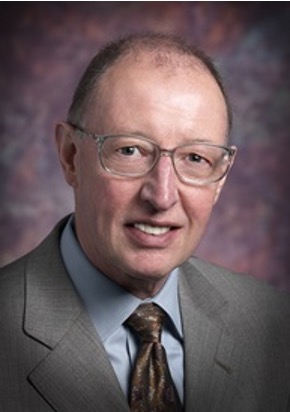
Prof. Ron Rohrer receives ACM SIGDA Pioneering Achievement Award @ DAC 2023
For the introduction and evolution of simulation and analysis techniques that have supported the design and test of integrated circuits and systems for more than half a century.
The CADathlon Brasil 2022 – 2nd Brazilian Programming Contest for Design Automation of Integrated Circuits (https://csbc.sbc.org.br/2022/cadathlon-brasil-en/) took place on August 2nd in Niteroi, Rio de Janeiro State, Brazil, as a co-located event of the 42nd Annual Congress of SBC (Brazilian Computer Society). It was organized by Federal University of Santa Catarina (UFSC) and Fluminense Federal University (UFF) and sponsored by ACM/SIGDA, IEEE CEDA (Council on Electronic Design Automation), SBC/CECCI (SBC Special Committee on Integrated Circuits and Systems Design) and SBMicro (Brazilian Microelectronics Society). It was financially sponsored by Synopsys, Chipus Microelectronics, ACM/SIGDA and IEEE CEDA.
As in the first edition, CADAthlon Brasil 2022 followed the same format as the ACM/SIGDA CADathlon, which happens annually co-located with ICCAD (International Conference on Computer-Aided Design). During the whole day, 15 two-person teams of students coming from different regions of Brazil worked to solve 6 practical problems on classical EDA topics such as circuit design & analysis, physical design, logic synthesis, high-level synthesis, circuit verification, and application of AI to design automation. The problems were prepared by a team of researchers from industry and academia.
This year the first place was won by team “turma da Monica”, from University of Brasília (UnB), formed by Enzo Yoshio Niho and Eduardo Quirino de Oliveira, and the second place was won by team “Rabisco UFSC”, from the Federal University of Santa Catarina (UFSC), formed by Arthur Joao Lourenço and Bernardo Borges Sandoval. The top 2 teams were awarded money prizes offered by Synopsys.
The CADAthlon Brasil 2022 Organizing Committee greatly thanks the Congress of SBC organizers for the logistics support, the problem preparation team and all sponsors, specially the financial support from Synopsys, Chipus Microelectronics, ACM/SIGDA and IEEE CEDA (through the South Brazil Chapter), which made it possible to cover the travel expenses of the competitors, making the event a huge success.
The next edition of CADathlon Brasil will occur as a co-located event of the 43rd Annual Congress of SBC, in July 2023, in Joao Pessoa, northeast region of Brazil.
Photos:
CADathlon Brasil 2022: team “Turma da monica”, winner of the First PlaceCADathlon Brasil 2022: team “Rabisco UFSC”, winner of the Second PlaceCADathlon Brasil 2022: the laboratoryCADathlon 2022 all teams and organizersCADathlon Brasil 2022: the organizers, the societies representatives and the Platinum sponsor representativeCADathlon Brasil 2022 banner at the lab doorCADathlon Brasil 2022 dinner & award session: third place awardingCADathlon Brasil 2022 dinner & award session: second place awardingCADathlon Brasil 2022 dinner & award session: first place awarding (representative professor from UnB)