ACM/SIGDA is pleased to announce that nominations are now open for the 2026 award cycle. We encourage the EDA community to recognize and celebrate outstanding contributions across career stages:
🔹 ACM Outstanding Ph.D. Dissertation Award in Electronic Design Automation (OPDA)
Recognizes an exceptional Ph.D. dissertation with substantial contributions to EDA theory and/or practice. 📅 Deadline: April 30, 2026 More details: ACM Outstanding PhD award
🔹 ACM/SIGDA Pioneering Achievement Award
Honors an individual for lifetime, outstanding contributions and sustained impact in electronic design automation. 📅 Deadline: April 10, 2026 More details: Pioneering Achievement Award
🔹 SIGDA Outstanding New Faculty Award (ONFA)
Recognizes a junior faculty member demonstrating exceptional promise and impact in EDA research and education. 📅 Deadline: April 30, 2026 More details: Outstanding New Faculty Award
We strongly encourage members of the community to submit nominations and help highlight the remarkable achievements of our colleagues.
Student Research Forum at ASPDAC 2026 — Highlights and Award Winners
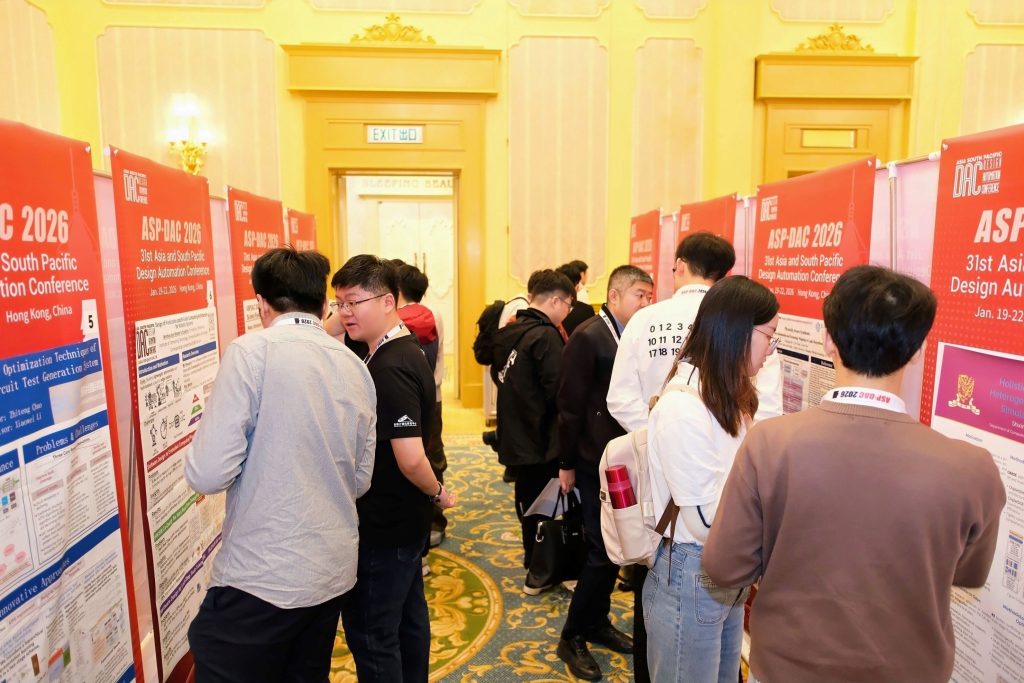
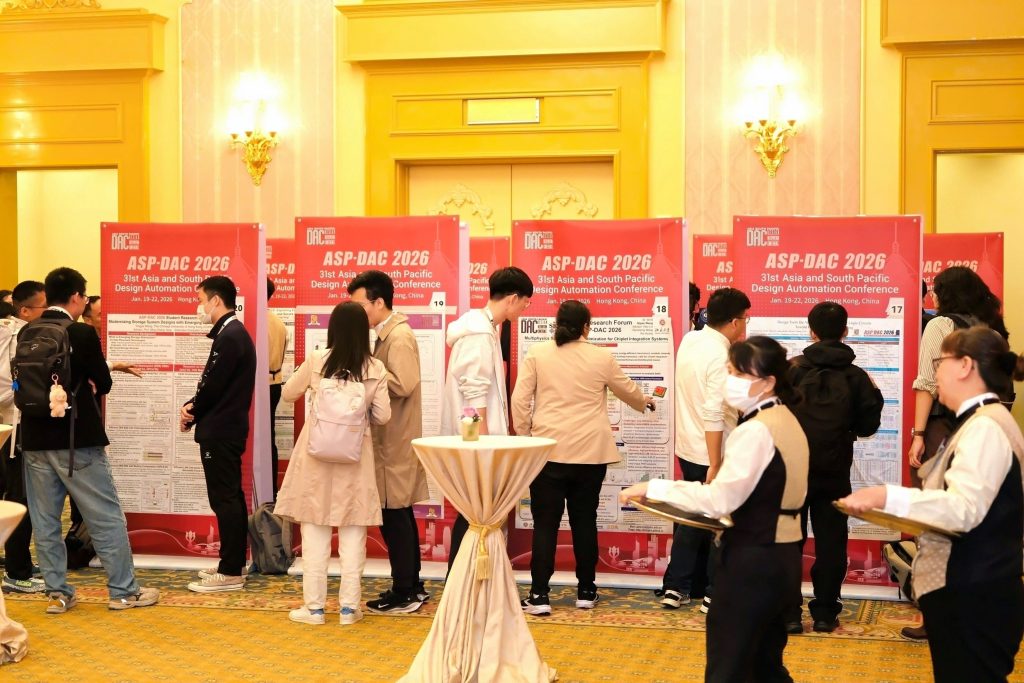
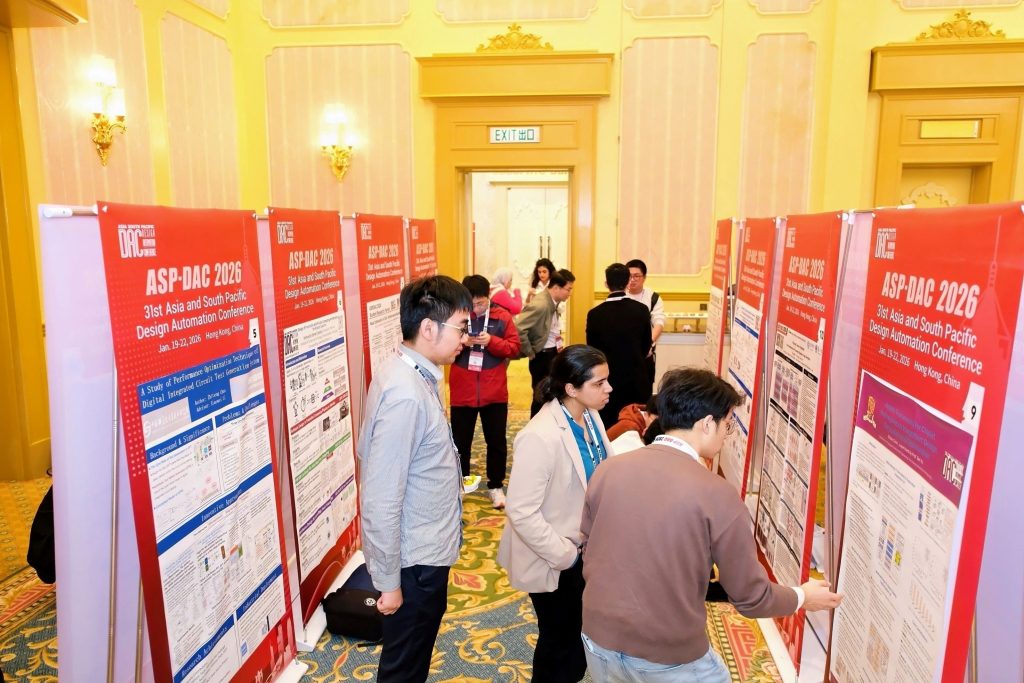
The Student Research Forum (SRF) at ASP-DAC 2026 was a vibrant showcase of emerging research and student innovation. This year, the forum received 39 submissions, with 29 posters accepted—a record-high number for the SRF—and three awards presented to recognize outstanding contributions across research quality, presentation, and community engagement.
🏆 SRF Award Winners
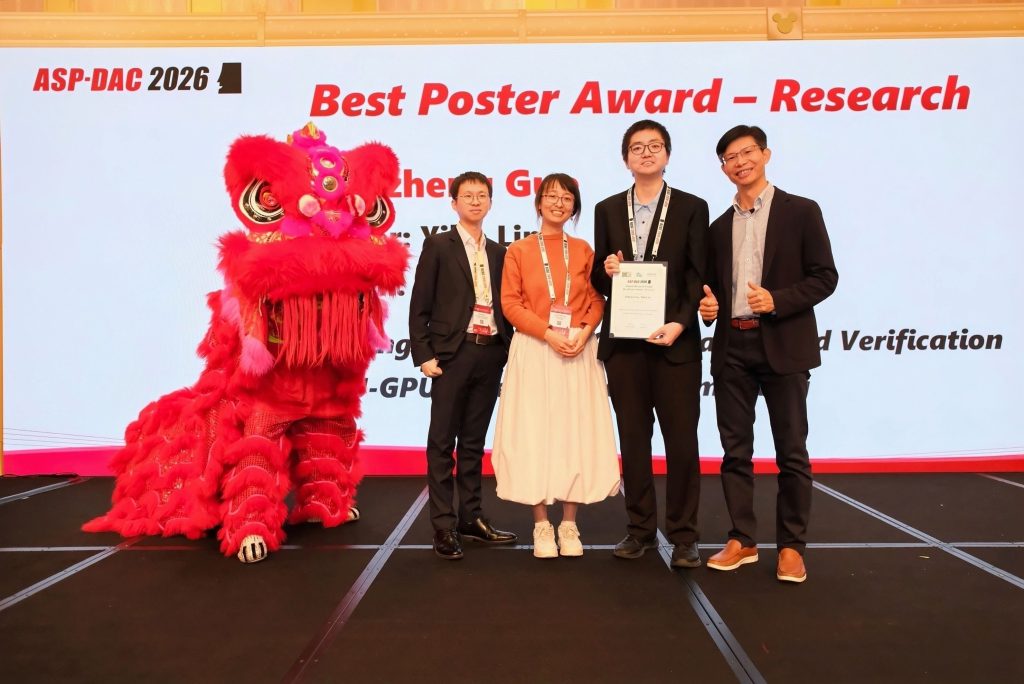
Best Poster Award – Best Research Zizheng Guo, supervised by Yibo Lin (Peking University)
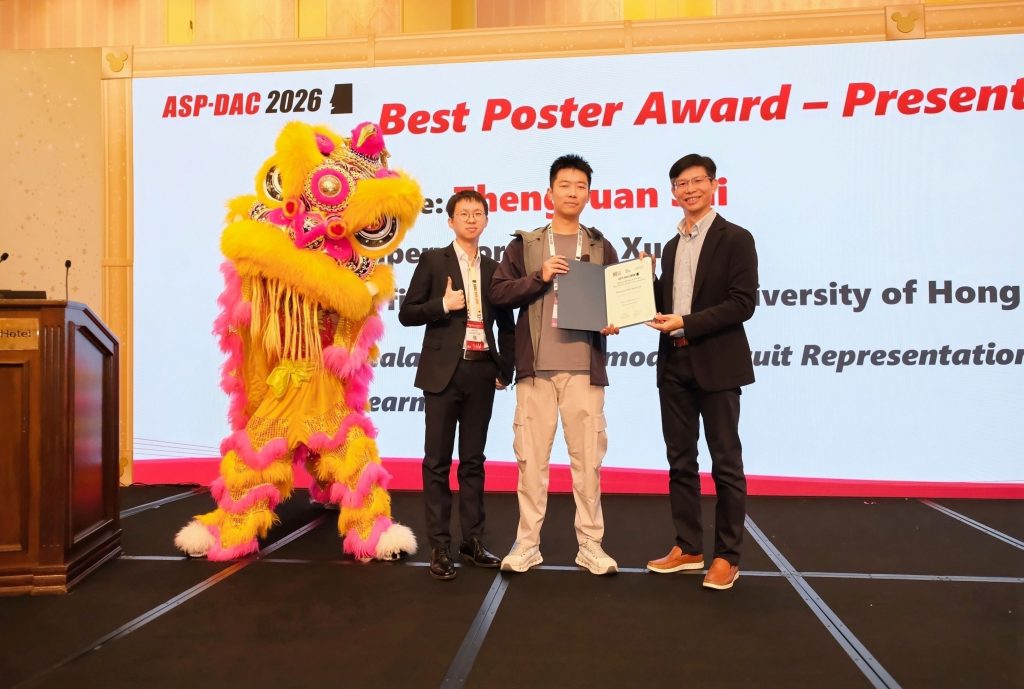
Best Poster Award – Best Presentation Zhengyuan Shi, supervised by Qiang Xu (Chinese University of Hong Kong)
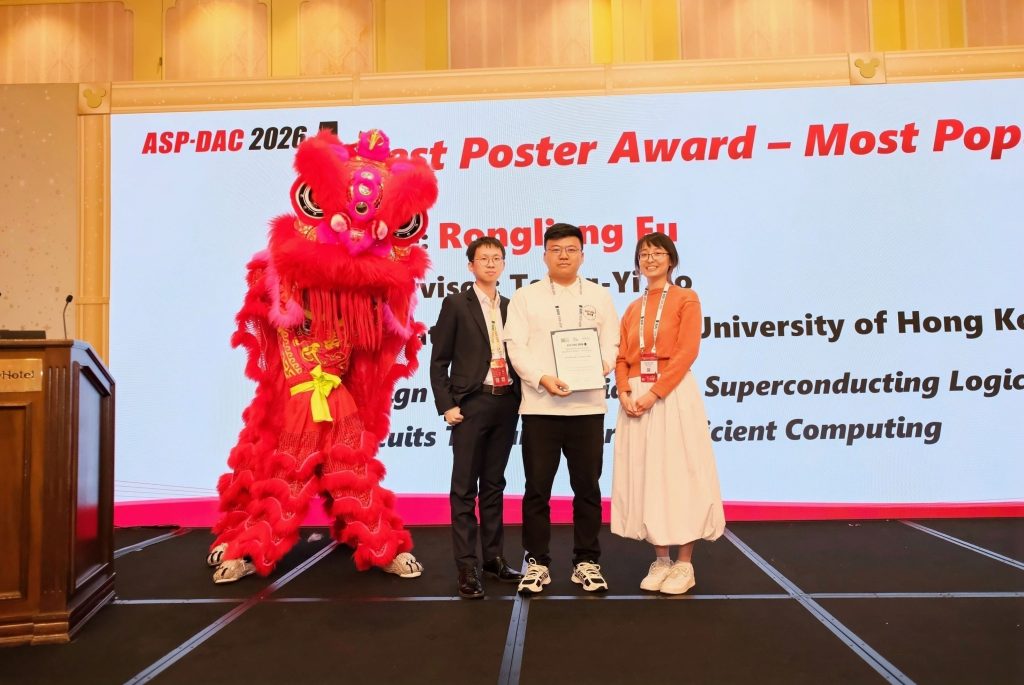
Best Poster Award – Most Popular Rongliang Fu, supervised by Tsung-Yi Ho (Chinese University of Hong Kong)
📸 Event Highlights
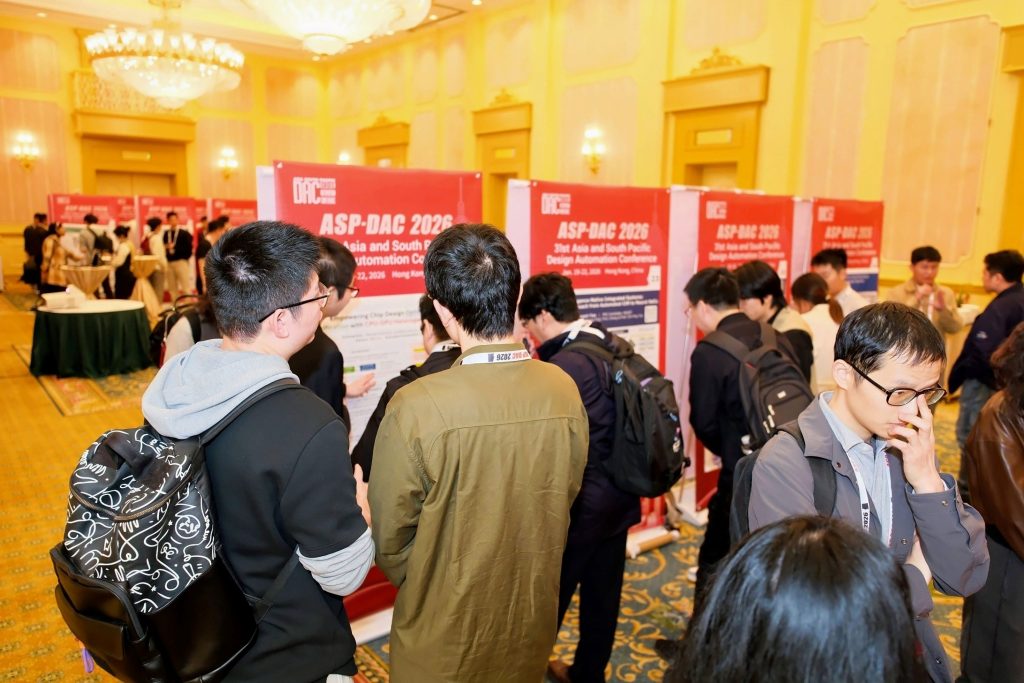
Highlights from the SRF award ceremony and poster session at ASP-DAC 2026.
👩⚖️ Award Judges
We sincerely thank the award judges for their careful evaluation and dedication to fairness. Poster assignments were made with strict conflict-of-interest (COI) considerations. (In addition to the judges listed below, other SRF committee members contributed to the first-round review; they are not listed here.)
Jianlei Yang — Beihang University
Zhenge Jia — Shandong University
Lang Feng — Sun Yat-sen University
Shiju Lin — Hong Kong University of Science and Technology (Guangzhou)
Hongce Zhang — Hong Kong University of Science and Technology (Guangzhou)
Yuzhe Ma — Hong Kong University of Science and Technology (Guangzhou)
Qi Sun — Zhejiang University
Bonan Yan — Peking University
Zhiang Wang — Fudan University
Zhiding Liang — Chinese University of Hong Kong
Cong “Callie” Hao — Georgia Institute of Technology
Yibo Lin — Peking University
Vidya A. Chhabria — Arizona State University
Xiang Chen — Peking University
Andy Yu-Guang Chen — National Central University
The SRF continues to be a cornerstone for student engagement at ASP-DAC, fostering dialogue, feedback, and visibility for early-stage research. Congratulations to all participants and award recipients!
Organizer: Zhiyao Xie, Hong Kong University of Science and Technology
ACM TODAES 2026 Call for Nominations: Best Paper Award, Rookie Author of the Year Award, Test of Time Paper Award
ACM Transactions on Design Automation of Electronic Systems (TODAES) is seeking nominations for the 2026 TODAES Best Paper Award. The nomination deadline is February 10, 2026.
All papers published in the ACM TODAES between January 2025 and December 2025 are eligible. The best paper will be selected based on originality, timeliness, potential impact and overall quality.
The award will be announced and recognized during the 2026 Design Automation Conference, July 26-29, 2026, Long Beach, CA.
A nomination should include the following material:
Name and email of the nominator
Title and author list of the paper, and the issue in which the paper was published
A brief supporting statement of no more than 200 words
A PDF copy of the paper
Submit the nominations using this link: https://forms.gle/jLdGSSa6uSkac3bA9. For any questions, email Ann Franchesca Laguna, Managing Editor of ACM TODAES, at ann.laguna@dlsu.edu.ph.
Both nominations by peers and self-nominations are welcome.
Contacts:
Ann Franchesca Laguna at ann.laguna@dlsu.edu.ph
Jiang Hu: jianghu@tamu.edu
TODAES Rookie Author of the Year (RAY) Award
ACM Transactions on Design Automation of Electronic Systems (TODAES) introduced the TODAES Rookie Author of the Year (RAY) Award, which aims to highlight the achievement of junior researchers in the Design and Design Automation of Electronic Systems field. Specifically, the award recognizes an author whose first-ever peer-reviewed journal paper as a lead author is published in ACM TODAES.
The lead author of a paper refers to the author who contributed the most to the submission. Since people may adopt different ways to order the authors, any nomination for the RAY Award must make it clear that the nominee is the lead author. If two authors satisfy this requirement (meaning they made equal contributions and are both rookie authors), both can receive the RAY award.
We are now seeking nominations for the 2026 TODAES RAY Award. The nomination deadline is February 10, 2026. All papers published in the ACM TODAES between January 2025 and December 2025 are eligible. The RAY award will be selected based on originality, timeliness, potential impact, and overall quality. The RAY award will be announced and recognized during the 2026 Design Automation Conference, July 26-29, 2026, Long Beach, CA.
A nomination should include the following material:
Name and email of the nominator
Title and author list of the paper, and the issue in which the paper was published
Confirmation that the paper is the first peer-reviewed journal publication in ACM or IEEE, where the nominee is the lead author.
A brief supporting statement of no more than 150 words.
A PDF copy of the paper
Submit the nominations using this link: https://forms.gle/36YAq2TZ6cemxrdVA by February 10, 2026. If you have questions, e-mail Ann Franchesca Laguna at ann.laguna@dlsu.edu.ph, Managing Editor of ACM TODAES, at ann.laguna@dlsu.edu.ph. No self-nomination is allowed.
ACM Transactions on Design Automation of Electronic Systems (TODAES) introduced the TODAES Test of Time Paper Award. This award will recognize an outstanding paper that was published in TODAES at least 10 years ago and has created a significant impact in the field of EDA.
We are now seeking nominations for the 2026 TODAES Test of Time Paper Award. The nomination deadline is February 10, 2026. As the inaugural Test of Time Paper Award selection, eligibility is restricted to papers published in ACM TODAES between January 1996 and December 2005. The award will be selected based on evident impact in the field of EDA. The award will be announced and recognized during the 2026 Design Automation Conference, July 26-29, 2026, Long Beach, CA.
A nomination should include the following material:
Name and email of the nominator
Title and author list of the paper, and the issue in which the paper was published
A brief supporting statement of no more than 200 words
One sentence quote that summarizes the impact of this paper
A PDF copy of the paper
Submit the nominations using this link: https://forms.gle/55NajeW5eU6YqUtH8 by February 10, 2026. If you have questions, e-mail Ann Franchesca Laguna at ann.laguna@dlsu.edu.ph, Managing Editor of ACM TODAES, at ann.laguna@dlsu.edu.ph. No self-nomination is allowed.
The IEEE Computer Architecture Letters (CAL) seeks applicants for the position of editor in chief (EIC), begin on 1 January 2027 and are for two years, pending reappointment for an additional two years, unless noted otherwise below.
This role provides an opportunity to lead the journal’s editorial direction, ensure high-quality and timely publications, and serve the computer architecture research community.
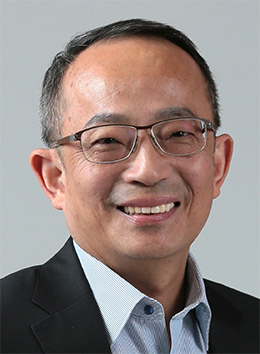
The ACM/SIGDA Pioneering Achievement Award recognizes individuals whose lifetime contributions have fundamentally shaped the field of electronic design automation (EDA). SIGDA is pleased to announce that Professor Tim Kwang-Ting CHENG has been selected as the recipient of this distinguished honor for his decades-long, transformative impact on EDA, VLSI design, verification, and cross-disciplinary research that bridges electronics, photonics, computer vision, and medical image analysis.
About the ACM/SIGDA Pioneering Achievement Award
The ACM/SIGDA Pioneering Achievement Award honors a person for lifetime, outstanding contributions within the scope of electronic design automation, as evidenced by pioneering ideas, influential publications, industrial products, and lasting impact on research and practice.
Past awardees represent the most influential leaders in EDA, including pioneers in design automation, verification, simulation, logic synthesis, VLSI systems, and hardware description languages.
Award items include a plaque, a citation, and a $1000 honorarium funded by the SIGDA annual budget. The award is typically presented at DAC and recognized again at the SIGDA Member Meeting and Dinner at ICCAD.
About Professor Tim Cheng
Vice-President for Research and Development, HKUST Chair Professor, ECE & CSE, HKUST Director, HKUST–WeBank Joint Lab PhD, Electrical Engineering and Computer Sciences, UC Berkeley
Professor Tim Cheng is an internationally renowned researcher, educator, and academic leader whose work has deeply influenced the fields of electronics testing, design verification, electronic and photonic design automation, computer vision, VLSI, and medical image analysis.
Academic and Leadership Roles
Prof. Cheng joined HKUST in 2016 as the Dean of Engineering and currently serves as the Vice-President for Research and Development. Before HKUST, he was a long-time faculty member at UC Santa Barbara (UCSB), where he held numerous major leadership roles including:
Associate Vice-Chancellor for Research (2014–2016)
Acting Associate Vice-Chancellor for Research (2013)
Chair, Department of Electrical and Computer Engineering (2005–2008)
Founding Director, Computer Engineering Program (1999–2002)
Prior to academia, he spent five years at AT&T Bell Laboratories, contributing to early advances in computing and communication technologies.
Research Excellence and Impact
Prof. Cheng is a world authority on design verification, electronics testing, and design automation of electronic and photonic systems. His pioneering contributions have influenced both academic research and industrial practice.
Key achievements include:
Over 500 technical papers, 5 books, and 12 US patents
Leadership of the U.S. DoD MURI Center for 3D Hybrid Circuits
Twelve Best Paper Awards and one Distinguished Paper Citation
Recognized as a Top 10 Author in DAC’s Fourth Decade
Numerous influential contributions transferred into commercial products
Fellow of IEEE and the Hong Kong Academy of Engineering Sciences
In 2020, he secured HK$443.9 million from Hong Kong’s InnoHK initiative to establish the AI Chip Center for Emerging Smart Systems, a major multi-university research center advancing IC and AI chip design.
Service to the EDA Community
Prof. Cheng has been an active and dedicated contributor to the global EDA community:
Former Editor-in-Chief, IEEE Design & Test of Computers
Member, IEEE CEDA Board of Governors
Member, IEEE Computer Society Publications Board
Contributor to ITRS technology working groups
Advisor and collaborator across academia, industry, and government
His sustained service and leadership have helped shape research directions, technology roadmaps, and the cultivation of future generations in the design automation community.
Congratulations to Professor Tim Cheng
SIGDA extends its warmest congratulations to Prof. Cheng on receiving the ACM/SIGDA Pioneering Achievement Award, recognizing his exceptional technical achievements, scholarly leadership, and profound lifetime impact on the field of electronic design automation.
SIGDA Financial Hardship Waiver (FHW) Program 2026
Starting January 1, 2026, all ACM publications (including those from SIGDA-sponsored conferences) will be 100% Open Access under ACM’s new publishing model. Authors whose institutions are not part of the ACM Open program will be required to pay an Article Processing Charge (APC) unless they qualify for a waiver or discount.
To ease this transition and ensure inclusiveness, SIGDA has established the Financial Hardship Waiver (FHW) program for 2026. This initiative, jointly funded by ACM and SIGDA, provides a limited number of waivers to cover APCs for eligible authors presenting at SIGDA-sponsored conferences.
Eligibility Criteria
Requests will be evaluated according to ACM’s and SIGDA’s guidelines. To qualify, all of the following conditions must be met:
All authors must be affiliated with institutions not participating in ACM Open.
The corresponding author must be a current SIGDA member.
Papers with co-authors affiliated with for-profit companies are not eligible, as such organizations are expected to cover publication costs for their employees.
Priority will be given to authors from low-income countries or from institutions and research groups without active grant funding. Additional documentation may be requested.
Application Procedure
Waiver requests can only be submitted after the paper is accepted, during the ACM e-rights process. Authors should select the waiver request option available within the ACM e-rights system and provide the requested information. Requests will be jointly evaluated by the Program Chair of the respective conference and the SIGDA FHW Committee based on the established eligibility criteria.
—
For more information about ACM Open, participating institutions, and ACM’s waiver policy, please visit: https://libraries.acm.org/acmopen
Yuan-Hao received his Ph.D. in Computer Science from the Department of Computer Science and Information Engineering at National Taiwan University, Taipei, Taiwan. He is currently a Deputy Director and Research Fellow (Professor) of Institute of Information Science (IIS), Academia Sinica, and is also a Jointly Appointed Professor of College of Electrical Engineering and Computer Science, National Taiwan University (NTU), Taipei, Taiwan. Yuan-Hao has published more than 100 research papers, which were mainly published in top journals (including 50+ in premier ACM/IEEE Transactions, e.g., IEEE TC, IEEE TCAD, IEEE TVLSI, ACM TECS, ACM TODAES, and ACM TOS) and top conferences (including 50+ in USENIX OSDI, ACM/IEEE DAC, ACM/IEEE ICCAD, ACM/IEEE ISLPED, ACM/IEEE CODES+ISSS, ACM/IEEE EMSOFT, ACM/IEEE CASES, IEEE RTSS, and IEEE RTAS). His work received 2 best paper awards from top conferences (including ACM/IEEE ISLPED 2020 and ACM/IEEE CODES+ISSS 2019), 4 best paper nominations from top conferences (including ACM/IEEE DAC 2016, ACM/IEEE DAC 2014, ACM/IEEE CODES+ISSS 2014, and ACM/IEEE DAC 2007), 2 best paper awards from important conferences (including IEEE NVMSA 2019 and IEEE IMW 2018), and 1 best paper nomination from important conference ACM/IEEE ASP-DAC 2016. He has also been granted for dozens of US and Taiwan patents.
Yuan-Hao is an associate editor of IEEE Transactions on Emerging Topics in Computing (TETC), ACM Transactions on Storage (TOS), and ACM Transactions on Cyber-Physical Systems (TCPS). He is currently an executive committee member of ACM Special Interest Group on Design Automation (SIGDA) and ACM Special Interest Group on Embedded Systems (SIGBED). He is a steering committee member of IEEE Non-Volatile Memory Systems and Applications Symposium (NVMSA). In addition, He served as a program co-chair and a general co-chair of IEEE NVMSA 2017 and 2018 respectively, and a local co-chair of ACM/IEEE International Symposium on Low Power Electronics and Design (ISLPED) 2017. He has also served as a program committee member for many top international conferences (e.g., ACM/IEEE DAC, ACM/IEEE DAC ICCAD, ACM/IEEE ISLPED, IEEE RTSS, IEEE RTAS, ACM/IEEE CODES+ISSS, and IEEE ICDCS).
Reasearch highlights
Yuan-Hao’s most significant contribution lies in the development of design methodologies for reliability enhancement of flash-memory storage systems with performance consideration. He was one of the pioneers to show the importance of wear leveling. He introduced the concept of static wear leveling and provided insights on how to improve the lifetime of flash-memory storage systems in the popular flash management designs. This work was nominated by DAC’07 for the best paper award and technically transferred to companies. His work on low-cost flash-memory products proposed the innovative ideas of “disposable flash memory” and provided solutions (e.g., committing information to resolve the ECC problem) to the software design of highly unreliable flash-memory products. By taking vertical integration into consideration, he further developed a file-system-aware flash management design to optimize the performance of flash storage devices. This is one of the first works to vertically integrate host information with device information. The current open-channel SSDs and zone namespace SSDs also follow the idea of vertically integration. The series of his research works has been the groundwork for developing highly reliable and efficient flash-memory storage systems, and has been adopted and validated on real products.
Another distinctive contribution of Yuan-Hao’s work is on developing HW/SW co-design methodologies to enhance reliability of non-volatile memory (NVM). Yuan-Hao was one of the pioneers to enhance the reliability/endurance of NVM through co-design methodologies. He proposed the concept of “one-memory” with a joint management method to resolve the lifetime issue of NVM. This work received best paper nomination from CODES+ISSS’14. Yuan-Hao further proposed the a constant-cost wear leveling design and provided insights on how to achieve wear-leveling with nearly-zero search cost; this work was one of the first to develop wear-leveling techniques for NVM-based main-memory systems. The series of his research works has been the groundwork to enable NVM as main-memory. Yuan-Hao also worked on developing co-design methodologies to resolve the reliability issue of 3D flash-memory chips. His work on 3D flash-memory was an early work to resolve the disturbance issue of 3D flash-memory. This work proposed a co-design solution with the concept of “virtual block” to reduce the disturbed bit errors with its extended design nominated by DAC’14 for the best paper award. His co-design works for 3D flash-memory have been adopted/validated on real 3D flash-memory chips.